Frequently Asked Questions
What does a natural gas leak smell like?
Natural gas is odorless on its own, so utilities add a chemical called mercaptan that smells like rotten eggs or sulfur. That distinctive odor is your first and most reliable warning — but odor fade, soil filtering, or a reduced sense of smell can mute it, which is why hissing sounds, dead vegetation, and appliance behavior are also worth watching.
Can a gas leak go unnoticed if there is no smell?
Yes. Odor fade in new piping, soil filtering the odorant out of an underground leak — common with dense clay soils — or simply having a diminished sense of smell can all hide a leak from your nose. That’s why professionals use combustible-gas detectors and pressure testing rather than relying on odor alone, and why it’s smart to know the non-smell warning signs too.
Will a carbon monoxide detector catch a natural gas leak?
No. Carbon monoxide detectors only detect CO, which comes from incomplete combustion — not unburned natural gas itself. Some combination alarms do include a combustible-gas sensor, so check what your specific device actually detects. For natural gas leaks, a dedicated combustible-gas detector near gas appliances adds a useful layer of protection alongside your CO alarms.
Should I shut off the gas meter myself if I smell gas?
Only if you can do it safely from outside and you know exactly how — the meter shutoff valve typically requires a wrench and a quarter-turn, and the valve may be stiff or corroded on older meters. If there’s any doubt, or if the smell is strong, don’t attempt it: evacuate and let the utility or emergency responders handle the shutoff. Never re-enter a building to turn gas back on yourself.
Who should I call about a suspected gas leak in Leander?
First, call your gas utility’s emergency line or 911 from a safe location outside the building — in the Austin metro area the natural gas utility responds to suspected leaks, shuts off gas when needed, and makes the area safe. For the repair work after the immediate danger is resolved — locating the leak on your side of the meter and fixing it — call us at (512) 877-2533.
How do professionals pinpoint the exact location of a gas leak?
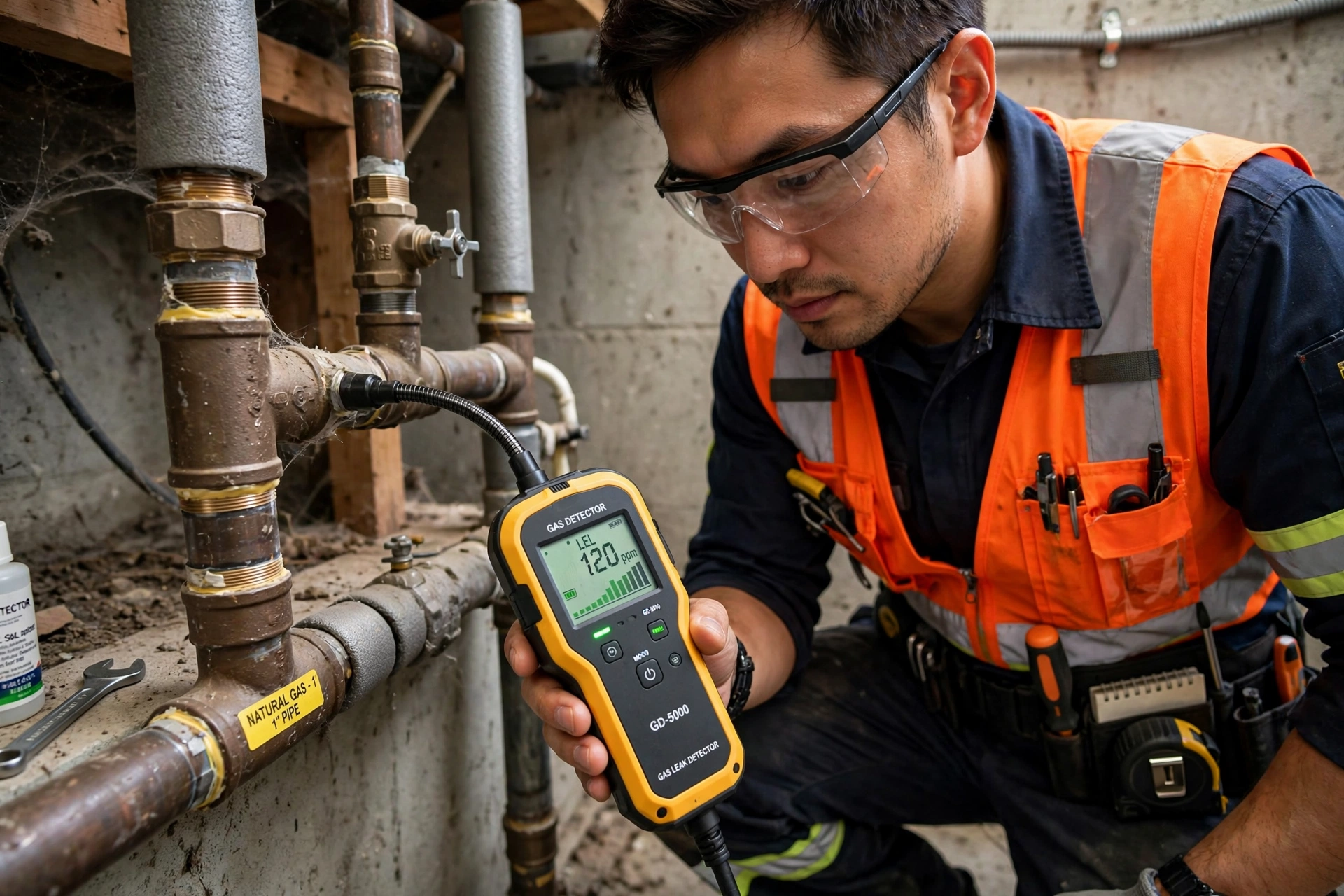
Technicians use combustible-gas detectors and electronic sniffers for indoor leaks, pressure testing to confirm which section of piping is losing gas, and targeted excavation for underground leaks. The goal is always to find the precise failure point — a cracked fitting, a corroded section, a damaged connector — so the repair is surgical rather than exploratory.